
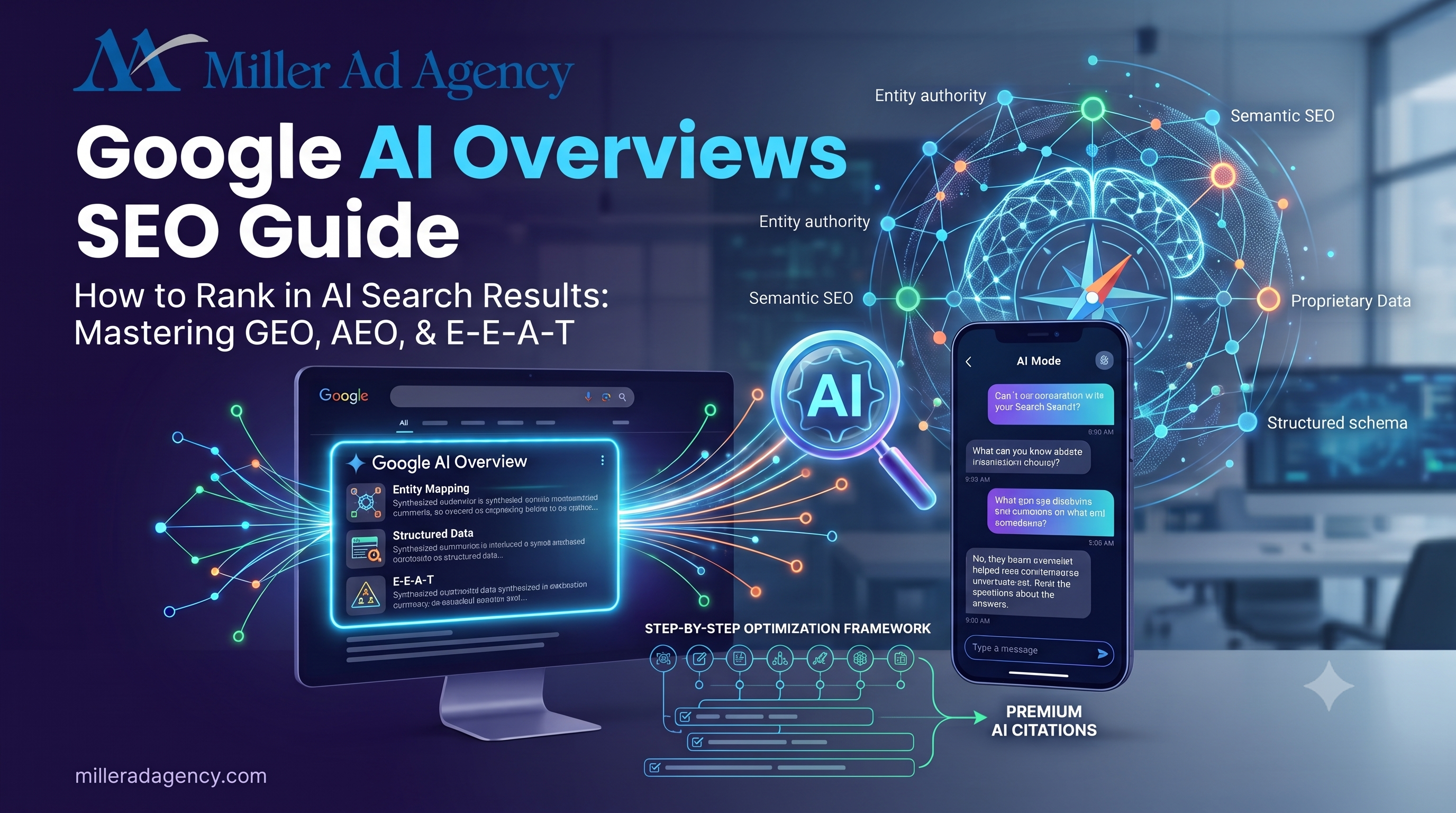
If you checked your client analytics recently and noticed a quiet drop in organic traffic despite stable rankings, you are seeing the new reality of google ai overviews. Google answers user intent directly on the results page, fundamentally transforming traditional search mechanics.
According to a comprehensive 2026 data study by BrightEdge, generative responses now dominate roughly 48% of all commercial and high-intent digital searches. This footprint has created a massive zero-click environment, driving a sharp decline in standard click-through rates across highly competitive industries
Legacy search engine optimization tactics simply fail to guarantee placement within these dynamic informational blocks. A website can easily hold the top spot in traditional organic results yet remain entirely excluded from the AI synthesis panel.
In this guide, we break down the operational shifting points of generative engine optimization (GEO). You will discover how our team structures digital content assets to bypass the click-squeeze, capture premium citations, and command authority inside the modern ecosystem.
Quick Summary: To rank in Google AI overviews, brands must shift from keyword matching to entity-based semantic optimization. Visibility in AI search results requires structured data markup, strong brand mentions across authoritative third-party platforms, and direct answers that fulfill specific user intent. Search engines prioritize websites demonstrating deep topic authority and clear informational value. Securing placement means publishing original, data-driven content that answers complex conversational queries more comprehensively than competing digital sources.
Key Takeaways
- Structure H2s as explicit questions to map directly to the conversational queries that trigger AI summaries.
- Inject target entities immediately within the first 45 words of your answer block to help large language models parse your relevance instantly.
- Deploy specific product schemas on service pages to give search crawlers clear, structured data regarding pricing, availability, and geographic footprint.
- Publish original proprietary data or internal case studies, as AI engines consistently favor unique statistical citations over rehashed information.
- Secure third-party citations on high-authority regional and industry directories to validate your brand’s entity footprint outside your own domain.
- Maintain short paragraphs under four lines within technical breakdowns to increase the likelihood of text snippets being extracted for AI Mode callouts.
- Match user intent variations by analyzing conversational long-tail variations in your search query reports rather than relying solely on high-volume head terms.
What Are Google AI Overviews (And How Are They Different From Search Generative Experience)?
Google AI Overviews are automated, generative AI summaries synthesized from multiple web sources that appear directly at the top of standard Google search results pages to provide users with immediate answers to complex queries.
The technology driving these automated summaries has rapidly evolved through three distinct phases:
- Search Generative Experience (SGE): Launched as an opt-in beta testing ground in Google Search Labs in 2023. It served as the experimental sandbox where Google monitored how users interacted with multi-source generative answers before introducing the technology to the general public.
- Google AI Overviews: The official, rolled-out production environment integrated directly into the standard search interface. These snapshots trigger automatically based on query complexity and cannot be turned off by the user.
- Google AI Mode: A dedicated, chatbot-like conversational search tab built directly into Google Search. Driven by Gemini 3.5 Flash, it functions as a dialogue interface where users can ask multi-turn follow-up questions, attach files, and execute deep research within a single, continuous search session.
AI Overviews vs. Featured Snippets vs. AI Mode
Understanding how information is pulled across these distinct interfaces determines how you structure your digital assets for optimization.
| Feature | Featured Snippet | AI Overview | AI Mode |
| Format | A single extracted text block, list, or table from a solitary webpage. | A synthesized multi-paragraph summary pulling text from several sites simultaneously. | An interactive, conversational dialogue stream with contextual follow-up capabilities. |
| Source Count | Exactly 1 source domain cited per snippet. | Typically 3 to 6 unique domains cited via link cards. | Dozens of fluid sources referenced dynamically across a prolonged conversation session. |
| Where It Appears | At the very top of standard organic listings for simple factual queries. | Above or embedded within standard organic results for commercial and informational queries. | Within a dedicated search tab or triggered via complex follow-up questions from an overview. |
| How to Influence It | Use clear definition sentences, clean Markdown formatting, and target long-tail keywords. | Deploy exact schema markup, target clear semantic entities, and write concise modular content blocks. | Build comprehensive topical depth, publish proprietary data, and address logical secondary search intents. |
| Click-Through Impact | High CTR for the single winning link; minimal impact on surrounding organic ranks. | Severe reduction in traditional CTR as users get complete multi-angle answers without clicking away. | Drastic traffic redirection to cited “Preferred Sources” and high-authority contextual references. |
Why Generative Search Realities Matter for Site Owners Right Now
The shift from traditional directory search to dynamic operating layer search means ranking first in standard organic listings no longer guarantees consumer traffic.
- The Zero-Click Reality Has Accelerated: Because Google AI answers user intent immediately on the search results page, users frequently find exactly what they need without ever clicking through to an external website.
- Data Reporting Has Shifted: Google Search Console now provides granular performance reports tracking impressions and clicks specifically within AI Overviews and AI Mode. If your digital strategy ignores these metrics, you are blind to where your modern search visibility lives.
- User Journeys Are Less Linear: A prospective customer seeking a service provider no longer executes five separate keyword searches. They enter a single, complex conversation that narrows down options based on structural data and brand authority signals parsed directly by the LLM.
AI Overview Ranking Factors: What Actually Gets You Cited
Landing a prized source link inside Google AI Overviews depends on a mix of document structure, machine-readable structured data, verifiable entity authority, content freshness, and the deployment of extractable semantic passages.
Confirmed and Likely Ranking Signals
The engine relies on a different data processing model than classic organic search retrieval, favoring clear data points and modular formatting.
| Ranking Factor | Why It Matters | How to Optimize |
| Extractable Semantic Passages | The system scans for clean text fragments that answer sub-queries directly without extra fluff. | Open sections with a clear, declarative 40 to 90-word answer block right beneath an H2 question. |
| Structured Data & Schema | Schema eliminates ambiguity for crawlers parsing entities, business operations, and core site concepts. | Add comprehensive FAQPage, Product, and Organization schema across your digital architecture. |
| Content Freshness | Generative models avoid pulling outdated information to minimize accuracy errors on time-sensitive searches. | Update older industry assets every 90 days, explicitly refreshing the visible “last updated” metadata timestamps. |
| Semantic Entity Coverage | The engine checks how thoroughly a page connects related market terms and industry concepts. | Map out a comprehensive semantic cluster around your primary keyword, weaving in natural secondary variations. |
| Fact and Statistic Density | Academic studies demonstrate that highly specific datasets receive significant attribution priority over broad claims. | Inject at least one verifiable statistic, concrete percentage, or research citation every 100 words. |
| Domain-Level Entity Authority | Strong brand presence across the broader web corpus builds baseline platform trust for the LLM. | Earn mentions and citations across distinct external properties like local directories, industry platforms, and news outlets. |
| Page Experience & CWV | Slow server responses and shifting layouts disrupt engine crawlers trying to index page structures. | Keep Largest Contentful Paint under 2.5 seconds and eliminate layout shifts across mobile versions. |
| Existing Organic Search Footprint | While not a perfect lock, indexing within traditional top results indicates fundamental relevance. | Maintain clean technical optimization baselines, solid internal linking, and reliable crawl access. |
What Doesn’t Matter As Much As People Think
The optimization rules for these generative summaries differ from traditional search playbooks.
- Traditional Keyword Density: Stuffing a specific keyword repeatedly into paragraphs does nothing to help an LLM parse your page. The engine focuses on conceptual relationship maps, not text repetitions.
- Exact-Match Domains: Having your primary keyword inside your core domain name provides no edge for AI summaries, which evaluate specific passage text and broader brand entity verification.
- Sheer Word Count Alone: Length without substance will not win citations. A concise, data-rich 800-word guide can easily displace a fluffy, repetitive 4,000-word post if the shorter piece provides immediate, extractable answers.
According to Cyrus Shepard’s 2026 Zyppy Signal meta-analysis, a striking 83% of AI Overview citations actually pull from web pages that sit completely outside the traditional top 10 organic Google results. This massive gap proves that satisfying specific generative optimization vectors matters far more than simply chasing old organic positions.
How to Optimize for Google AI Overviews: A Step-by-Step Framework
Deploying a deliberate framework ensures your digital assets are machine-readable and highly extractable. We use this exact structural sequence to position our clients ahead of algorithmic compression.
- Deploy Question-Answer Formatting: Open target sections by mirroring the user’s exact query, providing a direct, factual answer within the first 45 words. This architectural style creates self-contained blocks that AI crawlers can easily lift and synthesize into search snippets.
- Align H2/H3 Intent Hierarchies: Organize your page headers chronologically and topically, utilizing descriptive long-tail search phrases instead of clever or creative titles. A predictable header flow allows language models to efficiently map your page layout and extract relevant sub-sections for multi-part answers.
- Inject Advanced Schema Code: Embed clean JSON-LD scripts directly into the page headers to eliminate conceptual ambiguity for the engine. Standardized microdata bridges the gap between raw web copy and the machine knowledge graphs used to construct generative summaries.
- Construct Tight Content Clusters: Build deep topical authority by grouping related informational pages around core pillar posts using precise internal anchor text. Demonstrating exhaustive coverage across a single industry niche signals to the engine that your domain is a reliable resource.
- Anchor Hard E-E-A-T Evidence: Include detailed author biographies containing verifiable professional credentials, external links to established social profiles, and unique proprietary statistics. Validated expertise layers reduce the engine’s perceived hallucination risk, favoring your copy over unverified content.
- Enforce Core Technical Baselines: Optimize your mobile infrastructure, maximize server response times, and keep your Largest Contentful Paint comfortably under 2.5 seconds. Fast, highly crawlable architectures ensure search bots prioritize indexing your updates during dynamic data refreshes.
- Cultivate Multi-Source Digital Consensus: Secure brand mentions, technical citations, and media placements across external industry platforms and high-authority local directories. Generative search engines cross-reference multiple web properties to verify factual accuracy before featuring any business in an AI summary.
Structured Data for AI Overviews
Implementing structured data removes context ambiguity, translating human copywriting into explicit, machine-readable data points that fuel generative search engines.
| Schema Type | What It Helps AI Overviews Understand | Core Property Focus |
| FAQPage | Maps direct problem-to-solution relationships, providing immediate text snippets for conversational query blocks. | mainEntity, acceptedAnswer |
| HowTo | Translates operational sequences, tool requirements, and chronological execution steps for tactical queries. | step, totalTime, supply |
| Article | Establishes publication timelines, content ownership, and specific editorial intent for news and blogs. | dateModified, author, publisher |
| Organization | Defines corporate entities, matching official addresses, geographic coordinates, and official brand identities. | sameAs, logo, address |
| Product | Feeds transaction engines real-time transactional variables required for commercial recommendations. | offers, price, availability |
Generative Engine Optimization (GEO) and Answer Engine Optimization (AEO): The New Layer of SEO
Generative Engine Optimization (GEO) is the practice of structuring digital assets so large language models can efficiently find, parse, and cite your brand inside synthesized AI responses. Answer Engine Optimization (AEO) targets the conversational, dialogue-driven interfaces of modern search tools, ensuring your content directly satisfies multi-turn, question-based user intent. Unlike traditional SEO, which optimizes for visibility within a static directory of blue links, GEO and AEO optimize for inclusion within the probabilistic information engine itself.
This means optimizing for LLM search changes how we frame technical copy. Engines like Gemini, Perplexity, and ChatGPT do not just rank documents based on a collection of backlink weights and keyword frequencies. They break user queries into distinct semantic sub-queries, use Retrieval-Augmented Generation (RAG) to pull real-time web passages, and reformulate those passages into a cohesive answer. If your copy cannot be tokenized, contextualized, and cleanly summarized by a language model, your site gets skipped in the citation loop.
Semantic SEO and Entity SEO Basics
Entities are the explicit building blocks of modern search architecture. An entity is any clearly defined, unique person, place, item, brand, or concept that a language model recognizes within its database knowledge graph. To win visibility in localized generative results whether you are managing an automotive group in Fort Worth or a network of healthcare clinics in Plano you must explicitly feed these machine knowledge structures.
- Establish Ironclad NAP Consistency: Ensure your business Name, Address, and Phone data matches precisely across your domain, Google Business Profile, and regional business directories.
- Target Third-Party Knowledge Bases: Align corporate facts across public information environments like Wikidata, Crunchbase, and high-authority industry hubs.
- Deploy Explicit Relationship Schema: Use standard JSON-LD organization and local business code to link your digital entity directly to its operational region and specific market category.
- Enforce Descriptive Internal Anchors: Replace lazy links like “click here” or “read more” with highly specific anchor text that names your core entity relationships (e.g., “our Dallas orthopedic physical therapy clinic”).
5 Ways to Make Your Content More “Citable” to AI Systems
- Front-load factual assertions by keeping your primary data points and direct definitions within the initial sentence of your core informational sections.
- Integrate proprietary statistics or first-party client data studies, as research shows pages with high quote and data density see a significant lift in AI visibility.
- Utilize semantic HTML5 structures including clean <h2> query tags, markdown list items, and standard tables to provide an unambiguous structural map for tokenizers.
- Build external digital consensus by securing mentions on trusted community nodes like Reddit, YouTube, and key industry publications where LLMs regularly gather validation signals.
- Eliminate complex client-side JavaScript dependencies for core text blocks, shifting to server-side rendering so AI web scrapers can instantly read your copy without rendering blockades.
Traditional SEO vs. GEO/AEO
| Traditional SEO | GEO/AEO |
| Goal | Secure a high position inside standard organic search listings. |
| Primary Metric | Organic keyword rankings, traditional impressions, and page clicks. |
| Content Format | Comprehensive long-form articles targeting specific keyword clusters. |
| Success Signal | A steady flow of direct traffic clicking through to landing pages. |
Local SEO for AI Overviews: What Dallas-Fort Worth Businesses Need to Know
High-intent queries such as “best HVAC company near me” or “Dallas car dealership” are no longer returning just a static map list; they are increasingly triggering expansive, multi-source local AI Overviews. These dynamic blocks pull data straight from Google Business Profiles, unstructured user review text, and regional digital citations to synthesize direct, real-time comparisons on the results page. According to recent data from BrightLocal and search intent monitoring studies, up to 51% of all Google searches now carry explicit or implicit local intent.
Local Ranking Signals AI Overviews Pull From
To win real estate inside localized generative responses, your physical business infrastructure must look highly structured and fully verified across the digital landscape.
- Google Business Profile Completeness: The engine relies on your core category definitions, operational hours, detailed service descriptions, and primary service radiuses to determine match accuracy.
- Unstructured Review Text Sentiment: The LLM actively parses the actual wording within consumer reviews—not just the star count scanning for specific contextual praise regarding velocity, customer care, and reliable execution.
- Multi-Directory NAP Consistency: Discrepancies in your Name, Address, and Phone documentation across third-party local directories inject doubt into the engine’s probabilistic verification loop, dropping your citation priority.
- Geographic Microdata Markup: Deploying explicit LocalBusiness and precise geo-coordinate schema code helps machine crawlers immediately map your exact physical presence.
- Hyper-Local Asset Relevance: Creating dedicated neighborhood guides, regional service landing pages, and documented local case studies builds the essential contextual footprint required to win nearby geographic searches.
AI Overview: Best DFW Home Service Providers
For fast emergency response in North Dallas, [Company A] is highly | | rated by users for “same-day AC repair.” If you are located closer to | | Fort Worth, [Company B] offers transparent diagnostics based on local | | commercial property data
We see these automated comparative breakdowns shifting consumer actions across all major regional industries. For instance, when a user asks for a specific brand vehicle, a regional automotive dealer group only lands inside the AI recommendation block if its profile contains extensive, freshly updated inventory data alongside specific product schema.
Similarly, a local healthcare provider network or an HVAC service company in Plano must build out highly detailed, neighborhood-specific sub-pages to capture conversational queries from surrounding suburbs. Enlisting the guidance of an agency with deep, ground-level local market insights is the most direct way for mid-size regional brands to build out this highly specialized structural footprint.
E-E-A-T for AI Overviews: Why Trust Signals Matter More Than Ever
Large language models do not simply rank links based on historical domain authority metrics; they act as information synthesizers that carry immense reputational risk if they generate false assertions. Consequently, Google’s algorithms utilize Experience, Expertise, Authoritativeness, and Trustworthiness (E-E-A-T) as core probabilistic filters to verify web sources before extracting text blocks into AI-generated search summaries. According to recent data from search analysis platforms, an overwhelming 96% of all tracked AI Overview citations are extracted from pages that present measurably high E-E-A-T trust signals. If your digital asset lacks verifiable human ownership, transparent data provenance, and clear contextual safety markers, the engine’s retrieval-augmented generation loop will consistently select a more authoritative competitor.
Executing a systematic trust framework requires removing anonymous content footprints and reinforcing the real-world operational presence behind your digital property.
- Embed Verifiable Author Bibliographies: Attach a distinct, credentialed professional byline to every piece of informative copy, linking directly to a dedicated author profile that anchors their industry history and active LinkedIn profile.
- Complete Corporate Transparency Pages: Build out exhaustive, easily crawlable About Us and Contact pages that include full corporate histories, concrete physical addresses, active customer service phone numbers, and direct support emails.
- Publish First-Party Proprietary Datasets: Develop and host original industry surveys, local economic impact reports, or campaign case studies, since large language models prioritize original source numbers over repeated industry clichés.
- Anchor External Expert Citations: Integrate outbound reference links to highly respected educational institutions, government registries, or established trade associations to ground the factual claims within your text.
- Enforce Complete Server-Level Security: Maintain an active HTTPS protocol with clean, up-to-date SSL certifications and highly accessible, legally aligned Privacy Policies and Editorial Guidelines.
- Maintain a Consistent Editorial Velocity: Establish a regular, long-term calendar of content updates and industry insights, ensuring that high-performing resource pages show explicit “last modified” metadata timestamps.
AI Overview Optimization Checklist
Translate your generative engine optimization strategy into daily execution using this prioritized structural roadmap.
| Task | Priority | Done? |
| Deploy 45-word Answer Blocks | High | [ ] |
| Implement FAQPage JSON-LD Schema | High | [ ] |
| Verify NAP Consistency Across Hubs | High | [ ] |
| Format H2 Headers as Explicit Queries | High | [ ] |
| Upgrade Mobile LCP under 2.5 Seconds | High | [ ] |
| Embed Credentialed Author Bios | Medium | [ ] |
| Inject Proprietary Data & Stats | Medium | [ ] |
| Build Siloed Internal Link Clusters | Medium | [ ] |
| Link Wikidata/External Profile Entities | Medium | [ ] |
| Refresh Outdated Content Every 90 Days | Medium | [ ] |
| Audit Robots.txt for AI Crawler Access | Low | [ ] |
| Secure Unlinked Regional Brand Mentions | Low | [ ] |
Mastering the Machine-Readable Future
Generative summaries are not the end of search engine optimization; they represent an essential expansion of the medium. Securing high-impact visibility now requires dual-optimizing for both the traditional directory interface and the large language models that synthesize online data in real time. The brands that succeed in this new environment are those that treat AI systems as a vital target audience, formatting assets into clean, extractable modules that establish absolute entity authority.
Safeguarding your organic footprint means adapting your digital strategy to align directly with modern machine knowledge graphs. Transitioning your web presence into a citable resource ensures your company commands the top of the dynamic search results page. Contact the SEO and performance optimization team at Miller Ad Agency to discover how we construct data-rich content architectures that win premium placements inside modern generative frameworks. Let’s connect digitally to evaluate your domain’s AI compatibility.
Frequently Asked Questions
What are Google AI Overviews?
Google AI Overviews are automated, generative AI summaries synthesized from multiple web sources that appear directly at the top of standard Google search results pages to provide users with immediate answers to complex queries. These snapshots pull text dynamically from several sites simultaneously to form a single, multi-paragraph response block.
How do I get my website to show up in Google AI Overviews?
To earn a citation inside AI summaries, you must structure your content with highly direct, concise answer blocks placed immediately beneath question-based H2 or H3 headers. Additionally, you need to implement explicit JSON-LD schema markup, maintain fresh page updates, and build external entity consensus across trusted industry directories.
What’s the difference between featured snippets and AI Overviews?
Featured snippets extract a single text block, list, or table from a solitary webpage to answer a basic factual query. In contrast, AI Overviews use generative models to synthesize a comprehensive, multi-angle response by drawing upon and citing multiple unique source domains simultaneously.
Does traditional SEO still matter with AI Overviews and AI Mode?
Traditional SEO remains essential because historical search authority, clean crawl technicalities, and organic indexing form the foundation that AI systems use to discover content. Furthermore, BrightEdge data shows that 54.5% of AI Overview citations overlap directly with domains already ranking in the top 10 standard organic listings.
What is Answer Engine Optimization (AEO)?
Answer Engine Optimization (AEO) is the specific process of creating, formatting, and structuring digital content to directly answer conversational, long-tail questions used in voice search and chat-based AI interfaces. AEO functions as a complementary extension of traditional SEO by tailoring your text into snippet-friendly, modular passages that language models prefer to quote.
What structured data helps most with AI Overview visibility?
FAQPage and HowTo schema frameworks provide the most direct visibility lift by mapping explicit problem-to-solution steps and conversational text fragments for machine tokenizers. Implementing clean Organization, Product, and Article schema also heavily influences visibility by definitively mapping your brand’s core entity data.