
Key Takeaways
- OpenAI first dropped sponsored search results and conversational ads back in February 2026.
- Brands get direct access to a massive crowd typing 2.5 billion daily prompts.
- Expect clicks around $3–$5, which keeps it way cheaper than Google Search right now.
- Early testers already see 1.5x better conversion rates than old marketing channels.
- Any US business can jump in and run campaigns today using the self-serve platform.
Every single day, regular people type 2.5 billion prompts into OpenAI’s platform. They are looking for everything from quick vacation itineraries to direct software recommendations. Until recently, though, those high-intent queries stayed completely closed off to brands. That all changed in February 2026, when OpenAI quietly opened up the floodgates for commercial placements. Here at Miller Ad Agency, we have spent forty years guiding Dallas businesses through every single major shift in media buying. So we can tell you with absolute certainty: the arrival of ChatGPT advertising is the biggest real estate expansion we have seen in digital marketing since the early days of Google AdWords.
Right now, the early adopters are quietly locking in cost-per-click rates between $3 and $5. They are already seeing conversion rates 1.5 times higher than legacy marketing channels, mostly because these ads hit buyers exactly when they ask for a recommendation.
But look, this underpriced window won’t stay open for long. As soon as your competitors catch on and flood the auction, those ad costs are going to jump up fast. Getting in early lets you train your pixel, grab your market share, and lock in lower costs before the system gets crowded and way too expensive.
Read on to see exactly how this new auction works, what the ads look like on a screen, and how you can get a profitable campaign running before your competition even sets up an account.
Quick Summary: OpenAI introduced ChatGPT advertising in February 2026, integrating sponsored results directly into user conversations. This article explains how the new conversational ad auction functions and outlines current performance metrics. Average cost-per-click rates currently range from $3 to $5. This platform is best suited for US-based businesses seeking high-intent audiences and lower acquisition costs than traditional search channels.
What Are ChatGPT Ads? (The Simple Answer)
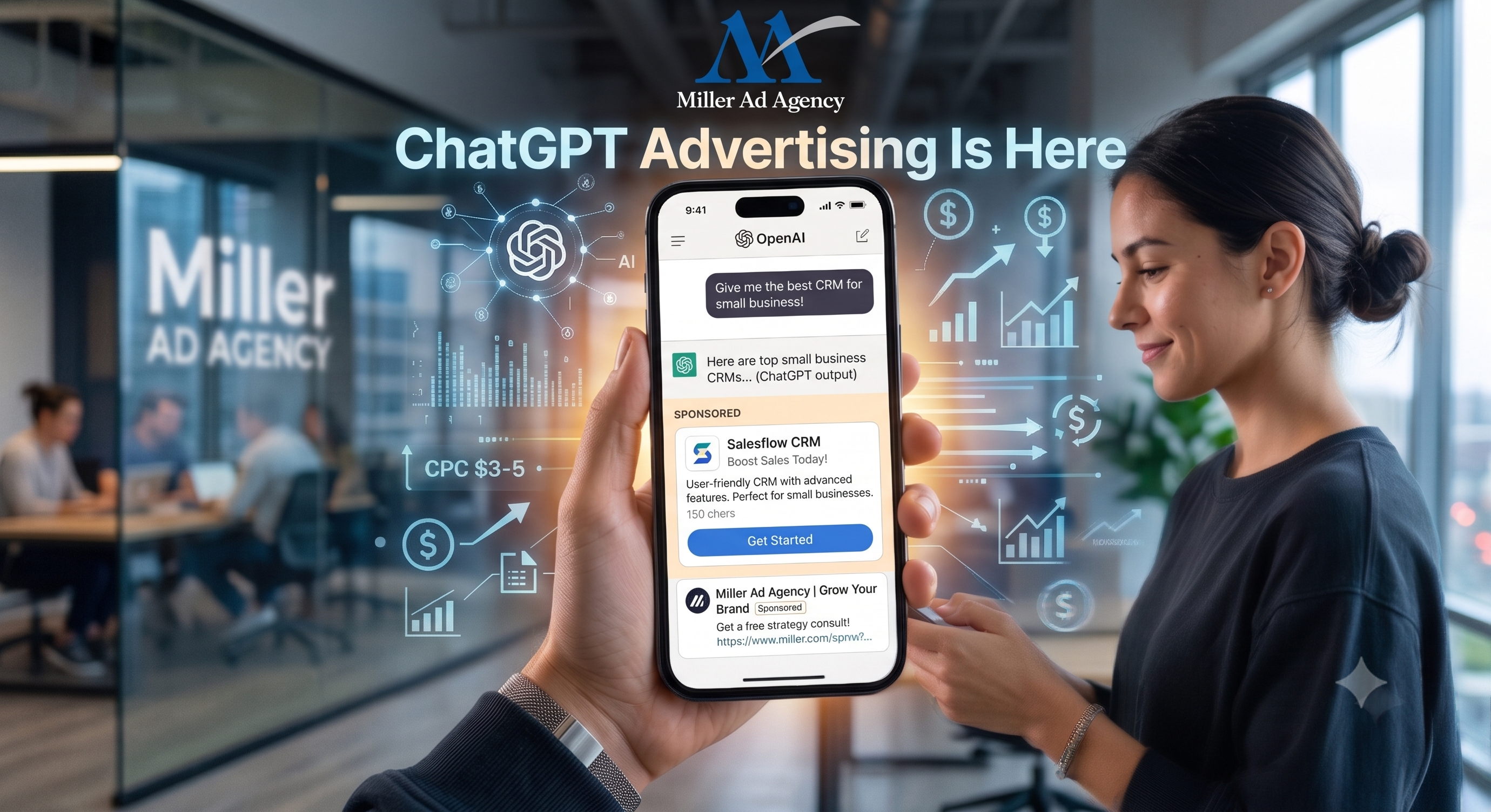
OpenAI officially dropped ads inside the ChatGPT interface back on February 9, 2026. Forget about those annoying static banners or invasive pop-ups. Instead, these placements appear naturally as visual “sponsored cards” tucked right at the bottom of your live chat window. They only show up when a user is deep in a conversation that signals a clear, obvious intent to buy a product or service.
Right now, OpenAI only shows these ads to US-based users who use the Free version or the budget-friendly $8-a-month Go-tier subscription. If you pay for Plus, Pro, or Enterprise, you won’t see them at all. Also, if you are worried that paid advertisers might mess with the quality of your answers, don’t be. OpenAI made it clear that ads do not touch or influence ChatGPT’s actual responses. The AI gives you its completely unbiased answer first, and the sponsored box sits entirely on its own down below.
At Miller Ad Agency, our team watches fresh marketing channels like this every single day just to keep our clients a step ahead of the competition. When a massive shift in user attention happens, the businesses willing to test the water first usually walk away with the most affordable leads.
How ChatGPT Ads Are Different From Google and Meta Ads
Old-school digital marketing depends heavily on older user data or rigid keyword matches. For instance, Google Ads sit there waiting for the exact search terms you punch into a search box. Meta Ads try to predict what you want by tracking your demographic profile, old browser cookies, and long-term habits across the web. ChatGPT ads throw those old targeting playbooks completely out the window. Instead, the platform looks at real-time conversational intent by reading the exact context of the live dialogue you are having right this second. Say a user asks the AI to map out a healthy weekly meal plan; a helpful sponsored card for a local Dallas grocery delivery service can pop up right then and there. It is a completely fresh approach to targeting built around instant, real-time helpfulness rather than tracking where someone went on the internet last week.
How Do ChatGPT Ads Actually Work?
Our media buying team at Miller Ad Agency spent a lot of time breaking down this network to drive ROI for our Dallas-area clients. The great thing here is that the system bypasses those annoying, multi-layered bidding setups you find on older ad networks. Instead, it relies on simple text cues and whatever the user is talking about right that second.
The Two Ad Formats Available Right Now
You can buy two different styles of ads for your campaigns today. The first option is a basic sponsored link. This setup drops your brand favicon, a clean “Sponsored” tag, and a direct link right next to the AI’s text answer. It stays visible on screen without breaking up the user’s reading flow.
The second option is a contextual placement. This is a much bigger, visual recommendation card that pops up underneath the AI’s final response when a user’s active conversation matches your exact business category.
Look, Miller Ad Agency evaluates ad format fit for each client before recommending a new platform. We do this because your creative assets have to match up perfectly with how your specific audience talks to an AI.
How ChatGPT Targets the Right Users
- OpenAI matches your business to active users by looking at three basic signals:
- What they are typing right now and their immediate needs.
- Stored chat history (only for logged-in users who keep personalization turned on).
- Anonymized intent groupings built out by the system.
The real difference between ChatGPT advertising and classic keyword bidding is something we call intent depth. Think about it this way: someone typing what is a CRM is just looking for a definition, so they get basic, high-level info.
But if a user types best CRM for small business, they are practically holding their credit card out. That specific phrase flags an immediate intent to buy, which drops a targeted sponsored card for a software provider right into the chat.
Don’t worry about privacy, either. Through this whole setup, the people reading your ads stay completely anonymous. Advertisers only get back basic, lumped-together performance metrics. You will never, ever be able to see individual user conversation logs or personal text transcripts.
ChatGPT Ads vs Google Ads vs Meta Ads: What’s the Difference?
Every platform has a specific strength, and the right choice depends entirely on your campaign goals. Here is an honest comparison of how AI search advertising stacks up against the established networks.
| Platform | Targeting Type | Avg CPC | Best For | Conversion Quality |
| ChatGPT Ads | Conversation intent | $3–$5 | High-intent buyers | 1.5x above average |
| Google Search Ads | Keyword intent | $2–$8 (varies) | Active searchers | High |
| Meta Ads | Behavioral/demographic | $0.50–$3 | Awareness + retargeting | Medium |
ChatGPT’s conversation-level intent is uniquely powerful because it captures users deeper in the decision-making process. Instead of guessing intent based on an isolated keyword or a past web-browsing habit, the system reads an active dialogue. When a user asks the AI to compare two specific service providers, your business can step into that exact moment with a timely placement.
However, this new platform should not replace your entire marketing mix. All three platforms play a distinct role in a healthy strategy. Meta excels at building top-of-funnel awareness, while Google captures users who know exactly what phrase to type into a search bar.
You must also consider current platform limitations. ChatGPT’s advertising ecosystem is still maturing, meaning its tracking, attribution, and reporting analytics are not yet as robust as the deeply established tools built by Google and Meta. Miller Ad Agency helps clients decide which platform mix fits their goals to maximize every ad dollar.
How Much Do ChatGPT Ads Cost in 2026?
Business owners and marketing directors want real numbers when planning their annual media spend. Our team at Miller Ad Agency has been tracking ChatGPT advertising costs since day one to help Dallas businesses budget effectively.
Currently, average cost-per-click rates hover around $3 to $5, making the platform highly competitive against traditional Google search placements.
Real-World Performance: Our Early Campaign Insights
While industry averages provide a helpful baseline, firsthand campaign data reveals the true potential of conversational advertising. In our initial thirty-day testing phase for a regional client, we shifted a portion of traditional search spend directly into the new OpenAI self-serve platform. The results highlighted a distinct behavioral shift in how users interact with native AI placements. Because the sponsored cards only triggered during deep, solution-oriented dialogues, our cost-per-acquisition dropped noticeably compared to legacy channels. We observed that users engaging with these conversational placements spent longer on the destination landing page and required fewer secondary touchpoints before converting. This confirms that aligning your creative assets with real-time conversational intent generates substantially higher quality leads.
What Early Advertisers Are Seeing
The financial barrier to entry has dropped drastically over the last few months. When OpenAI rolled out its initial pilot program in February 2026, it required a massive $200,000 minimum spend commitment that priced out all but the largest Fortune 500 brands.
That exclusive model shifted quickly. Driven by intense demand, OpenAI hit $100 million in annualized ad revenue within just six weeks of launch. By May 2026, the platform became fully self-serve with zero campaign minimums, allowing businesses of any size to launch a campaign through the OpenAI Ads platform.
Right now, early movers benefit from exceptionally low competition, which directly keeps the auction costs stable. Miller Ad Agency advises clients to test new platforms early before costs climb and competition increases.
History shows that as more brands inevitably flood the self-serve ads manager, ad inventory will shrink and bidding prices will rise. Securing your market share today ensures you lock in these profitable, lower cost-per-click rates before the platform becomes crowded.
Which Businesses Should Advertise on ChatGPT Right Now?
At Miller Ad Agency, we believe in giving honest advice rather than chasing every fleeting digital trend. Deciding to advertise on ChatGPT is a powerful addition to the marketing mix, but it is not a universal fix for every business model. We only recommend new channels when the data confirms a genuine alignment with your target audience and acquisition goals.
Industries That Are Already Winning on ChatGPT Ads
Certain sectors are uniquely positioned to convert ChatGPT traffic because users turn to the AI with high-intent, solution-oriented questions. Miller Ad Agency clients in these specific sectors are well-positioned to test the platform now:
Retail and e-commerce: Users constantly ask the AI to recommend the “best products to buy” for specific use cases, creating a perfect opportunity for direct product placements.
Local services (HVAC, legal, dental): Homeowners and patients use the platform to diagnose urgent problems and immediately ask for trusted local providers.
SaaS and software: The platform frequently fields detailed software comparison queries, making it easy to capture buyers evaluating your direct competitors.
Healthcare and wellness: Consumers actively research symptoms and treatment options, allowing wellness brands to offer timely, relevant solutions.
Financial services: Users regularly ask the AI to compare credit cards, loans, or insurance policies right before making a final purchasing decision.
Businesses That Should Wait (For Now)
While the platform offers great reach, it is not the right investment for every marketing budget or product type today. We advise waiting if your business falls into any of these categories:
- Budgets under $500/month: The platform’s early learning curve requires data testing, making it inefficient for very small monthly ad spends.
- Highly visual product categories: Brands relying heavily on aesthetics, such as fashion or fine art, will struggle on this text-first platform.
- Businesses without clean landing pages: ChatGPT traffic demands direct, clear pages to convert, so you must fix leaky funnels before buying ads.
How to Get Started With ChatGPT Advertising: A Step-by-Step Overview
Launching a campaign on this platform requires shifting your mindset from keyword bidding to conversation mapping. Below is the practical checklist our media buyers use to deploy and configure client campaigns properly.
| Step | Action | What You Need |
| 1. Register | Go to ads.openai.com, create your account, and verify your business entity. | Business email + website |
| 2. Build intent map | List 30–50 specific questions your target customers ask ChatGPT. | Customer research |
| 3. Write ad copy | Draft a 40-character headline and a 150-character conversational description. | Copywriter or agency |
| 4. Build landing page | Design a clean, direct web page that skips corporate jargon and delivers the offer. | Web developer |
| 5. Set up tracking | Append custom UTM parameters and connect the traffic to your CRM or Google Analytics. | Analytics access |
| 6. Launch & review | Take your campaign live, monitor CTR and conversion data, and adjust bids weekly. | Campaign manager |
Traditional keyword research focuses on isolated fragments that users type into search bars. Intent mapping beats keyword research for ChatGPT advertising because it focuses on complete thoughts. By mapping out full, multi-turn conversational queries, you match your sponsored cards to users who are actively seeking a comprehensive solution rather than a quick definition.
Managing all these moving parts independently can slow down your deployment and drain your ad spend. Partnering with a full-service team like Miller Ad Agency accelerates your results because we handle copy, landing pages, tracking setups, and strategy under one roof. This integrated approach ensures your messaging aligns perfectly with your tracking data, allowing your campaign to find profitability much faster.
What Miller Ad Agency Clients Need to Know About ChatGPT Ads
Since our founding in Dallas back in 1984, Miller Ad Agency has guided clients through every major shift in the media landscape. We helped businesses navigate the early days of Google Ads, the rise of Meta, the complexities of programmatic buying, and now, the introduction of ChatGPT advertising. Our forty years of experience mean we do not chase unproven trends; instead, we systematically evaluate new tools to determine exactly how they can grow your revenue.
For clients looking to explore this conversational channel, our team manages the entire workflow from start to finish. We handle your high-intent conversation mapping, draft native ad copy, design dedicated landing pages, configure precise UTM tracking, and provide ongoing campaign optimization. Whether you operate in automotive, healthcare, or home services, we ensure your ad spend targets the right users.
If you want to see if this new platform makes sense for your marketing goals, visit us at milleradagency.com. You can connect with a strategist for a straightforward, pressure-free consultation to discuss how to keep your business ahead of the competition.
Frequently Asked Questions
Q: What are ChatGPT ads and how do they work?
A: ChatGPT ads are conversational sponsored links and visual cards that appear natively inside a live chat window. The system analyzes the real-time context of your active dialogue rather than relying on historical tracking cookies. When your conversation signals an immediate intent to purchase, OpenAI matches a relevant business recommendation cleanly underneath the AI’s text response.
Q: How much do ChatGPT ads cost in 2026?
A: ChatGPT ads currently cost between $3 and $5 per click, depending on your target industry and competition level. While the platform initially required a massive $200,000 minimum budget during its early 2026 pilot phase, OpenAI shifted to a fully self-serve ads manager with zero campaign spend minimums, making the auction accessible to all businesses.
Q: Can small businesses advertise on ChatGPT?
A: Yes, any US-based small business can advertise on ChatGPT using the platform’s self-serve dashboard. However, because the system requires data to optimize properly, we recommend having an initial budget of at least $500 per month. You also need mobile-friendly landing pages that directly answer the user’s specific conversational search intent.
Q: Are ChatGPT ads better than Google Ads?
A: Neither platform is universally better, as they target entirely different stages of the buying journey. Google Search Ads excel at capturing users typing specific, isolated keywords into a traditional search bar. ChatGPT advertising captures users who are engaged in deep, multi-turn research, yielding conversion rates up to 1.5 times higher for complex queries.
Q: Is user data safe when ChatGPT shows ads?
A: User data remains safe because OpenAI only shares aggregate, completely anonymized performance metrics with its advertisers. Brands can see how many users clicked an ad or completed a purchase, but individual user identities and private conversation transcripts are never visible to businesses or third-party marketing tools.